
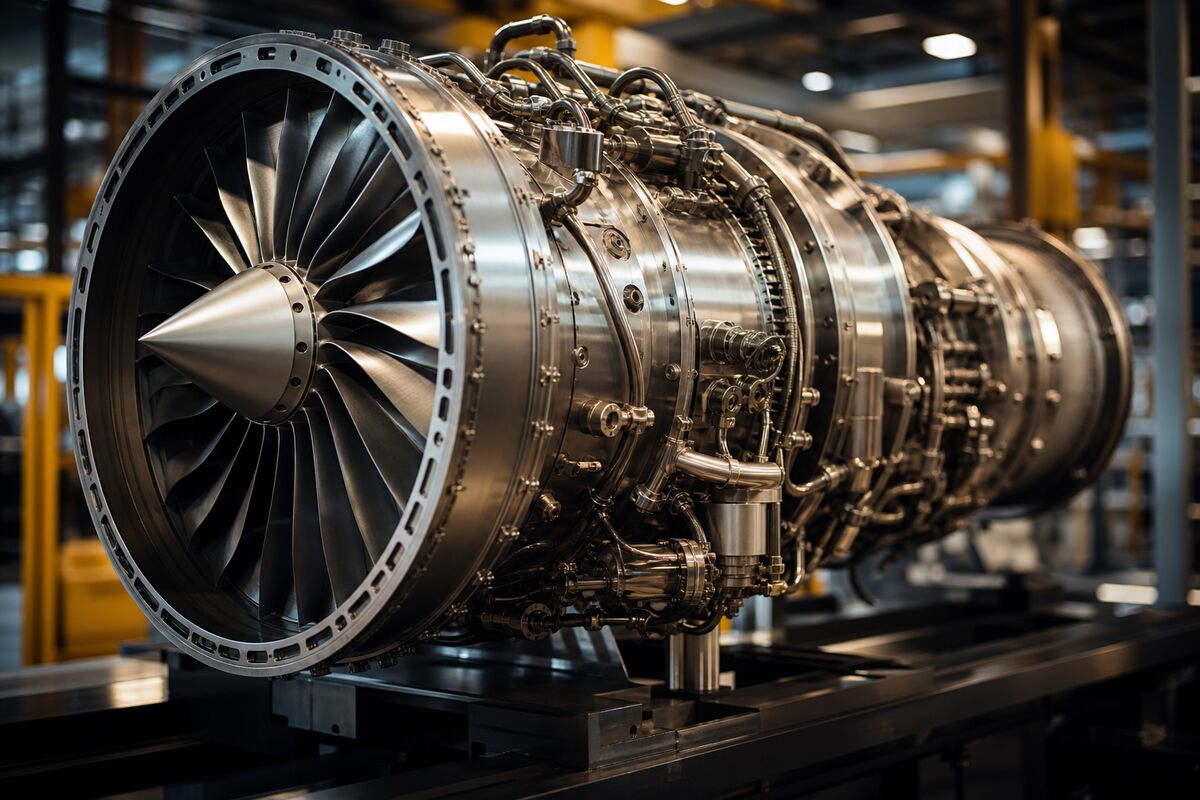
GE Aerospace ($GE) agreed on September 8, 2026 to buy Consolidated Precision Products, a Cleveland-based maker of jet-engine castings, from Warburg Pincus and Berkshire Partners for $11.75 billion in cash, and as of October 19, 2026 the deal is still pending, with closing expected in the second half of 2027. One clarification up front, since the abbreviation trips up Canadian readers: "CPP" here means Consolidated Precision Products. It has nothing to do with the Canada Pension Plan or its investment arm, CPP Investments. This is GE buying a key supplier of its own engine parts.
The price is steep. GE is paying about 26 times CPP's projected 2027 EBITDA before synergies. $GE closed at $313.83 on October 16, 2026, 6.9% below its last pre-announcement close. Below are the terms, the rationale, and the arithmetic behind both.
The terms
The figures come from GE's September 8 press release and investor presentation, both filed with a Form 8-K:
- Price: $11.75 billion cash purchase price, subject to closing adjustments.
- Sellers: private investment firms Warburg Pincus and Berkshire Partners.
- Financing: $7 billion of cash, with the rest in new debt.
- Valuation: about 18x 2027 EBITDA including expected net synergies, about 26x without.
- Synergies: about $200 million of net synergies, from productivity, supply chain and procurement.
- Returns: accretive to adjusted EPS and free cash flow in the first year, excluding one-time costs and deal-related amortization, with double-digit ROIC targeted by year five.
- Capital allocation: "No change," per GE.
- Timing: close expected in the second half of 2027, subject to regulatory approvals and customary conditions.
What CPP makes
CPP was founded in 1991. GE calls it one of the world's largest producers of investment and precision sand castings, in super alloy, titanium, aluminum, magnesium and steel. Its parts go into commercial and military aircraft, weapon systems, business jets, helicopters and industrial gas turbines. It has about 6,600 employees across more than 20 facilities.
GE's presentation puts CPP's 2027E revenue at about $2.0 billion. The split is roughly 60% commercial aerospace, 20% defense and 20% power and other, and about 70% of revenue comes from commercial and defense engines. CPP supplies castings for GE's LEAP, GEnx, T700, F110 and F404 programs, and GE has been a customer for more than 15 years. A Reuters analysis published September 9, 2026 described CPP as the world's third-largest maker of turbine-blade castings and cited Jefferies as saying CPP supplies a quarter of GE's needs.
Why GE says it is buying
The pitch is supply, not diversification. GE's presentation projects its airfoil demand, measured in parts, growing more than 30% from 2026E to 2030F across commercial engines, aftermarket and defense. CEO H. Lawrence Culp, Jr. said: "Investing in mission-critical casting capacity is needed to support the strong simultaneous demand across commercial engines, aftermarket and defense."
The second pitch is technology. Culp said the process and quality improvements GE expects to bring "also will ensure manufacturing readiness to deploy enhanced airfoil technology for a more reliable ramp," and GE plans to run its FLIGHT DECK lean system across CPP's plants. Reuters quoted Kevin Michaels of AeroDynamic Advisory on why castings are a bottleneck: "It's the black art of manufacturing, which has always been a huge barrier."
What has happened since
Not much in public filings. GE's only 8-K since the announcement, dated September 22, 2026, covered board committee changes. No regulatory clearance or closing had been announced as of October 19, 2026. Leeham News reported on September 9, 2026 that CPP is expected to run as a separate business unit and keep its existing customers, with the final structure depending on regulatory approvals. GE also said it will keep working with Howmet and ATI. Antitrust is the open question. Reuters quoted AlixPartners partner Matteo Peraldo: "I would expect GE to be required to divest certain facilities."
The math
Prices are closes from Financial Modeling Prep data. September 7, 2026 was Labor Day, so September 4 was the last close before the announcement.
| Measure | Inputs | Result |
|---|---|---|
| Implied 2027E EBITDA, standalone | $11.75B ÷ 26 | ~$452M |
| Implied 2027E EBITDA with synergies | $11.75B ÷ 18 | ~$653M |
| Price / 2027E revenue | $11.75B ÷ ~$2.0B | ~5.9x |
| New debt | $11.75B − $7B cash | ~$4.75B |
| $GE, announcement day | $337.12 (Sept 4) to $334.91 (Sept 8) | −0.7% ($SPY −0.5%) |
| $GE, two sessions | $337.12 to $325.42 (Sept 9) | −3.5% ($SPY −1.0%) |
| $GE, to October 16, 2026 | $337.12 to $313.83 | −6.9% ($SPY −0.9%) |
| Deal vs. GE market value | $11.75B ÷ ~$325.6B at $313.83 | ~3.6% |
The gap between the two implied EBITDA figures is about $200 million, which matches GE's net synergy target. So the 18x multiple assumes GE delivers all of it. Without synergies, a margin of about 23% (roughly $452 million on $2.0 billion) supports a 26x price tag only if castings stay scarce and CPP's output grows with GE's airfoil ramp.
The market's verdict has been cool rather than hostile. $GE lagged $SPY by about six percentage points from September 4 to October 16, 2026 (−6.9% vs. −0.9%). That is a meaningful underperformance, though price data alone cannot separate the deal from other news over six weeks. At about 3.6% of GE's market value, the purchase is digestible. The debt-plus-cash funding means it competes with buybacks for capital, even though GE says its capital-allocation plans are unchanged.
What to watch
- Antitrust filings and remedies, including whether regulators demand plant divestitures, as Peraldo expects.
- Customer reaction from engine makers that also buy CPP castings, and from suppliers Howmet and ATI, which GE says it will keep working with.
- Debt issuance of roughly $4.75 billion before the 2027 close.
- GE's third-quarter report, for any update on timing, financing or castings supply.
- Read-across to other aerospace supply-chain deals, such as TransDigm's acquisition, and to the build rates in Boeing's 737 MAX production push, which drive LEAP engine demand.
For more M&A and markets coverage, visit the What's On Finance homepage.
Bull/Bear Verdict
Bull Case: GE locks up a supplier that, per Jefferies via Reuters, supplies a quarter of its needs, while its airfoil demand is projected to grow more than 30% by 2030. GE expects the deal to add to adjusted EPS and free cash flow in year one, and at about 3.6% of GE's market value it does not strain the balance sheet.
Bear Case: 26x standalone EBITDA is a full price that needs every dollar of the ~$200 million synergy target to look reasonable. Closing is nearly a year away, regulators may force divestitures, and rival engine makers that buy from CPP may look elsewhere.
FAQ
Is this the Canada Pension Plan (CPP Investments)?
No. CPP here is Consolidated Precision Products, a Cleveland, Ohio castings manufacturer owned by Warburg Pincus and Berkshire Partners. The Canada Pension Plan and CPP Investments are not part of this transaction.
How much is GE Aerospace paying for Consolidated Precision Products?
$11.75 billion in cash, subject to closing adjustments. GE is funding it with $7 billion of cash and new debt for the remainder.
Has the GE-CPP deal closed?
No. GE expects it to close in the second half of 2027, subject to regulatory approvals. No clearance or closing had been announced as of October 19, 2026.
How did $GE stock react?
$GE closed at $334.91 on September 8, 2026, down 0.7% from $337.12 on September 4. By the October 16, 2026 close of $313.83 it was down 6.9%, against a 0.9% dip for $SPY.
Updated October 19, 2026: expanded with deal terms from GE Aerospace's 8-K filing, CPP's business mix, post-announcement developments and price data through the October 16, 2026 close.